






What are Pharmaceutical Excipients?
Pharmaceutical excipients are inactive ingredients added to drug formulations to improve manufacturability, stability, appearance, taste, dissolution, and bioavailability. Although they have no direct therapeutic effect, excipients play a crucial role in ensuring consistent pharmaceutical quality.
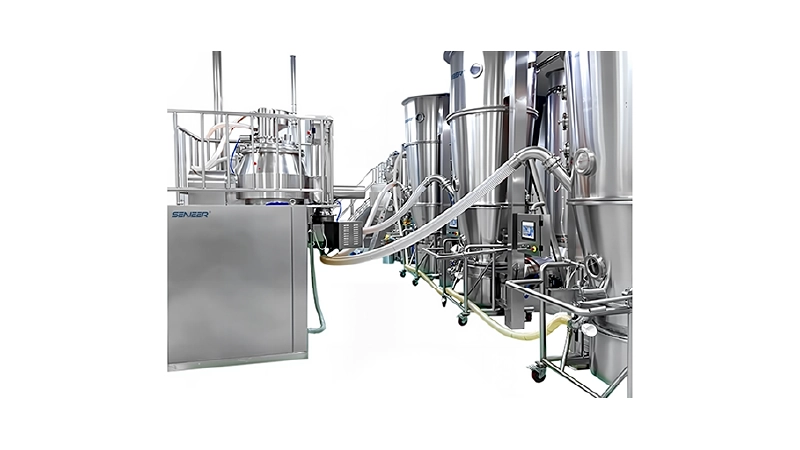
Pharmaceutical excipients play a critical role in tablet and capsule manufacturing. They influence powder flowability, granule strength, compressibility, dissolution rate, and final product stability. Selecting the appropriate excipient can significantly improve the performance of fluid bed granulation and downstream tablet compression.

Chapter 1:Types of Excipients Used in Granulation
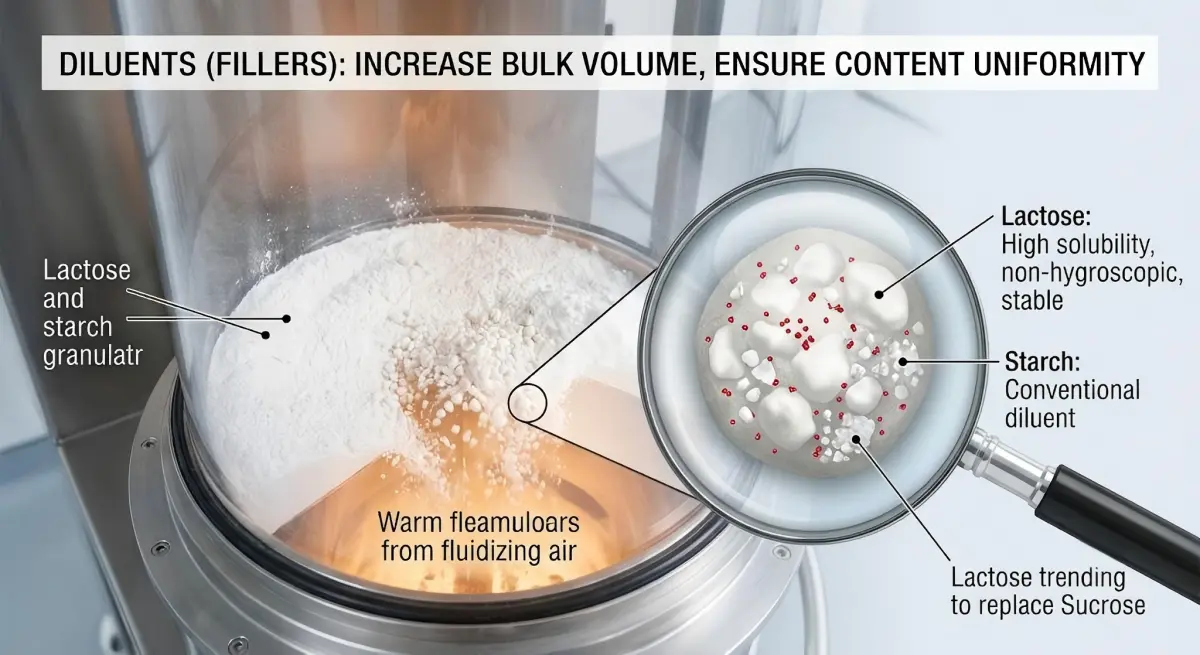
Diluents (Fillers) Diluents are the excipients with the highest dosage in fluid bed granulation formulations. Sucrose, dextrin and starch have long been used as traditional diluents. However, sucrose has high hygroscopicity, so lactose has been increasingly applied in recent years and is trending to replace sucrose as the primary diluent.
In addition to being non-hygroscopic, lactose features good water solubility and stable chemical properties. It does not react with most active pharmaceutical ingredients (APIs) and has minimal interference with API content assays. Besides lactose, mannitol, xylitol and bifidose are also commonly used excipients with flavor-correcting properties. Soluble starch, which has better solubility than ordinary starch, is also widely adopted as a diluent.
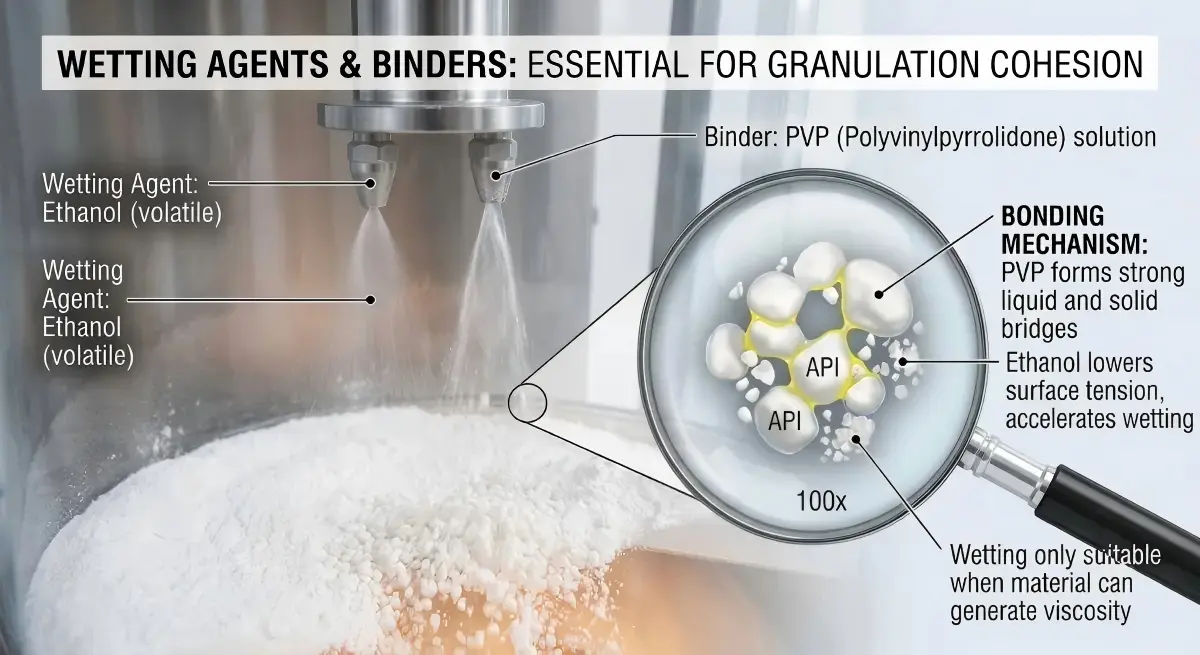
Wetting Agents and Binders Wetting agents and binders function to moisten and bind fine drug powders, and are essential excipients for producing qualified granules. When applying them, factors such as concentration, type selection and mixing uniformity with drug powders should be comprehensively considered. Water was the earliest primary wetting agent, but it produces granules with poor adhesion. Raw materials with high extract content tend to agglomerate when water is used as the wetting agent, so ethanol later became the mainstream wetting agent. As a volatile, semi-polar wetting agent, ethanol requires precise control of concentration and dosage, as well as accelerated stirring speed. Wetting agents are only suitable for materials whose soluble components can generate viscosity on their own. They only moisten powders and reduce surface tension, and have no inherent binding capacity.
For this reason, Senieer generally recommends using them in combination with Fluid bed granulation binders. Polyvinylpyrrolidone (PVP), soluble in both ethanol and water, is a chemically stable synthetic high-molecular polymer. It was initially used as a plasma volume expander, and later became a widely used binder for granule formulations. With excellent binding performance, stability, disintegration properties and solubility, it is expected to have broad market prospects in both western pharmaceutical and traditional Chinese medicine (TCM) preparation production.
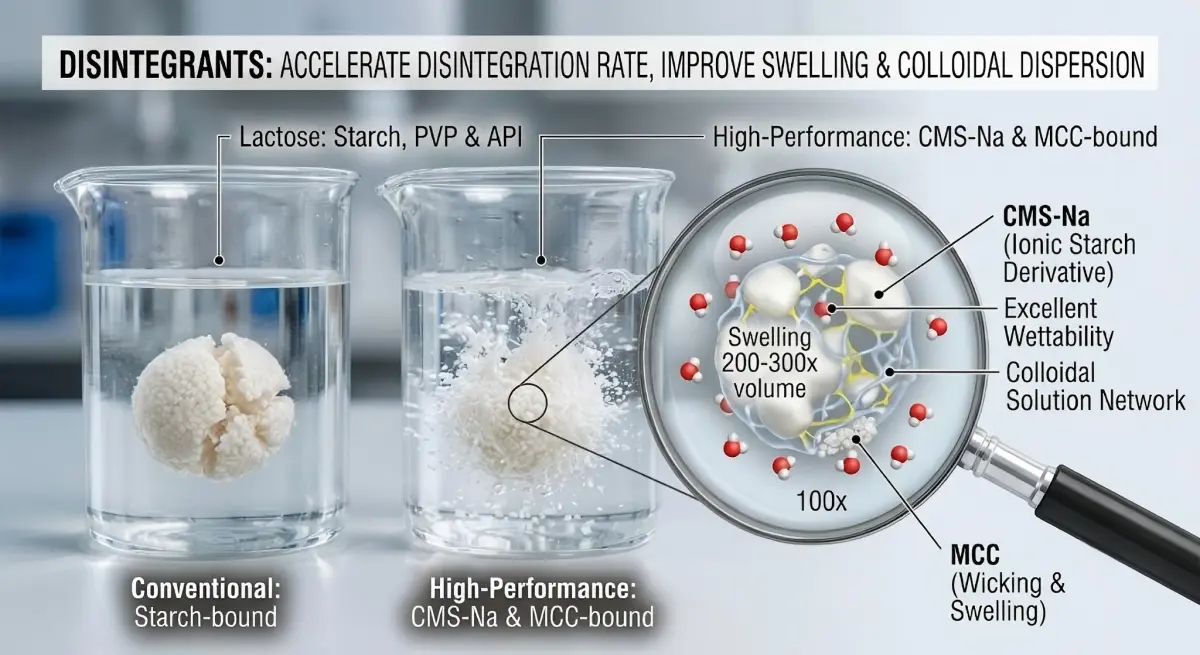
Disintegrants TCM extracts have high viscosity, and disintegrants can effectively improve the disintegration rate of TCM granules. Starch is the most commonly used conventional disintegrant.Carboxymethyl Starch Sodium (CMS-Na)and Microcrystalline Cellulose (MCC) are currently the primary high-performance disintegrants.
CMS-Na is a typical ionic starch derivative and a multi-purpose excipient. It disperses into a colloidal solution with a network structure in water, and is insoluble in ethanol. It has excellent wettability and swelling capacity: its volume rapidly expands 200–300 times upon water absorption, absorbing approximately 30 times its dry volume in water, without rupturing the granules. Its swelling degree is 3–5 times higher than that of starch, and its swelling performance is superior to microcrystalline cellulose. It is particularly effective as a disintegrant for alcohol-extracted TCM products. – MCC has been widely used as a disintegrant since the 1960s with reliable performance. It performs exceptionally well as a stabilizer in suspension-type granules, greatly reducing granule hygroscopicity and significantly improving pharmaceutical stability.
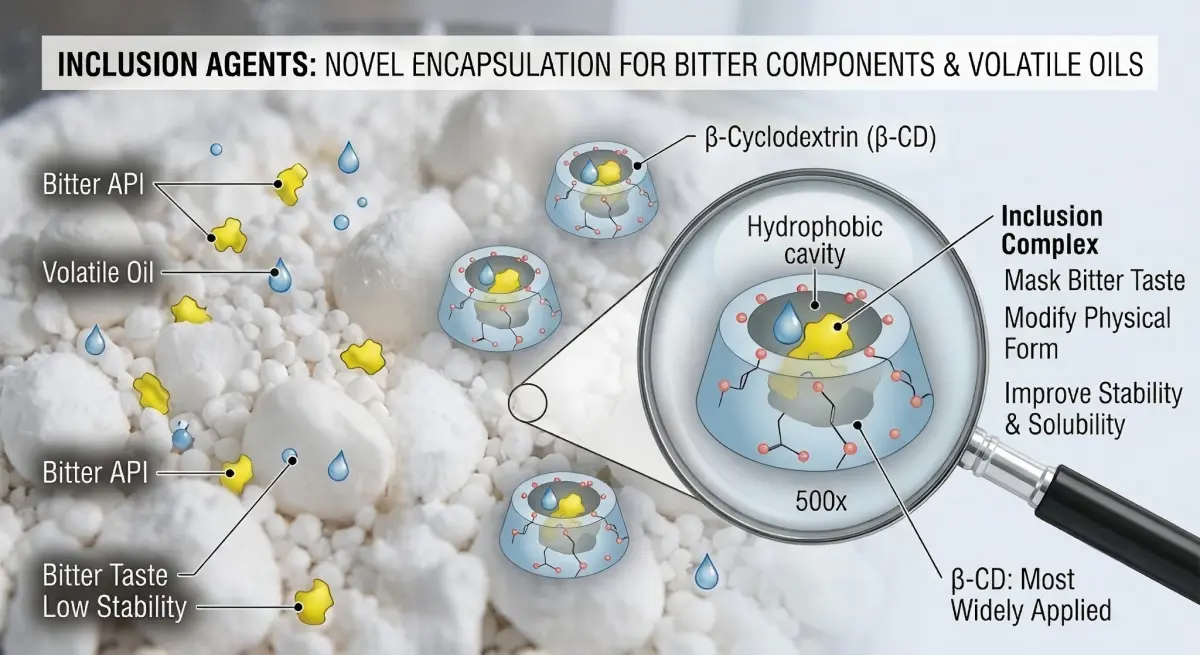
Inclusion Agents Inclusion agents are a novel type of excipient that can encapsulate bitter components and volatile oils. They can reduce the bitter taste of drugs, modify the physical form of liquid drugs, reduce drug irritation and side effects, and further improve drug stability and solubility. However, in the production of many TCM granules, volatile oils are mostly added via spraying, and inclusion technology is rarely used due to its high process cost. Current mainstream inclusion agents include α-cyclodextrin (α-CD), β-cyclodextrin (β-CD) and N-LOK modified starch, among which β-CD is the most widely applied.
Chapter 2:Do You Really Need that Many Types of Excipients?
The answer is no. With advances in chemical raw material technology, the introduction of multi-functional excipients has driven the optimization of granulation processes. For example, microcrystalline cellulose (MCC) serves multiple roles in formulations
Chapter 3:Why Use MCC?
Microcrystalline cellulose (MCC) serves multiple roles in formulations:
1.Structural filler
When high diluent dosage is required, it increases tablet weight and fill volume, improves powder fluidization, and prevents fine powder segregation caused by static electricity.
2.Dry binder
It exhibits inherent cohesiveness during the dry blending stage, assisting material agglomeration in both one-step granulation and dry granulation processes. In wet granulation, when combined with spray binding liquid, it enhances granule strength, and improves tablet hardness and compressibility.
3.Disintegrant
Its disintegration effect is far superior to formulations using only lactose or calcium phosphate.
4.Fluidization modifier
It makes the powder fluffy and porous, optimizes bed fluidization, reduces dead bed, wall sticking and fine powder entrainment in the fluid bed, and enables more uniform spray granulation.
5.Extract adsorption carrier
It can effectively adsorb extract components.
Chapter 4:How to Choose Excipients?
Practical Mainstream Formulation Solutions With over 21 years of experience in solid dosage form manufacturing, we have verified several practical, industry-proven formulation solutions.
General Immediate-Release Formulation
Formulation
API + Lactose Monohydrate (primary diluent) + MCC (multi-functional: filler / dry binder / disintegrant) + CMS-Na (internal disintegrant)
Spray binding solution
PVP K30 (liquid binder) dissolved in purified water
Application
Suitable for most common oral tablets and capsule granules; the preferred solution for mass production of chemical generic drugs
Features
Stable fluidization, uniform and spherical granules, and wide process tolerance window. Lactose provides excellent tablet compressibility, while MCC balances binding and disintegration performance, delivering the highest cost-effectiveness.
Equipment
Sugar-Free Health & Functional Formulation
Formulation
API + Mannitol (sugar-free primary diluent + flavor modifier) + MCC + Crospovidone (PVPP, super disintegrant)
Spray binding solution
Low-viscosity Hypromellose (HPMC E5) dissolved in ethanol-water solution
Application
Commonly used for sugar-free tablets, chewable tablets, buccal tablets, orally disintegrating tablets, health supplements, pediatric medications and sugar-controlled preparations.
Features
Cool, sucrose-free taste and uniform granule appearance. Inlet air temperature must be controlled below 60℃ to avoid mannitol melting and agglomeration.
Equipment
- Fluid bed granulator
- Liquid mixing tank
- …
Extract Granule Formulation
Formulation
Plant extract + Pregelatinized starch (primary filler + extract adsorbent) + MCC + small amount of maltodextrin
Wetting agent
60%–80% ethanol aqueous solution
Features
it significantly reducing extract wall adhesion; the ethanol system ensures rapid drying rates and prevents gelatinization-induced clumping; when extract viscosity is high, increasing ethanol concentration can prevent bed collapse.
Equipment
- Fluid bed granulator
- Liquid mixing tank
Special Formulation for Water-Sensitive / Heat-Sensitive Drugs
Formulation
API + Anhydrous lactose + Dibasic calcium phosphate dihydrate + Low-substituted hydroxypropyl cellulose (L-HPC)
Spray binding solution
Small amount of PVP K25 dissolved in anhydrous ethanol
Application
For drugs prone to hydrolysis in water and degradation at high temperatures, such as some antibiotics, vitamins and probiotic preparations
Features
Inorganic calcium salt isolates moisture, and the alcohol-based system enables short drying time. L-HPC has inherent dry cohesiveness, reducing liquid spray dosage and minimizing damage to drugs caused by heat and moisture.
Equipment
- Fluid bed granulator
- Liquid mixing tank
- Vacuum conveying
Chapter 5:What Can SENIEER Do?
Our pharmaceutical engineers have over 21 years of experience designing fluid bed granulation processes.
We can help you:
- Optimize formulations
- Improve granule quality
- Increase production efficiency
- Reduce formulation costs
Contact Senieer today for free technical consultation.
Why Choose SENIEER?
Senieer are known all over the world for our pharmaceutical equipment. We have over 37 years of pharmaceutical experience and have assisted 61 countries in solving pharmaceutical issues.
Senieer provide complete design, engineering, construction, start-up of new pharmaceutical facilities, even assisting the Clients through scouting activities.
Senieer project drivers satisfy all pharmaceutical regulatory and QA requirements, aligning the final product to the international Pharmacopoeias and capitalizing upon a careful, customer-oriented project management
Senieer offer a comprehensive End-to-End Solutions package that addresses all aspects of facility design, construction, and commissioning.