






What are Pharmaceutical Bins
Here, we referring to another type of material bin used for pharmaceutical powder handing. Bin as the common stain steel container that storage is the basic functions. With the process technology update, Bins have additional function, widely used pharmaceuticals ,nutrition, chemical, veterinary, cosmetics, food industry.
Many pharmaceutical manufacturers invest heavily in mixing systems and automated production lines, yet overlook one critical component—the material bin.
An improperly selected bin can lead to:
- Powder segregation
- Cross contamination
- Difficult cleaning validation
- Material bridging
- Production downtime
- High labor costs
Whether you are designing a new production line or upgrading an existing facility, choosing the right physical container is essential for product quality and GMP compliance.
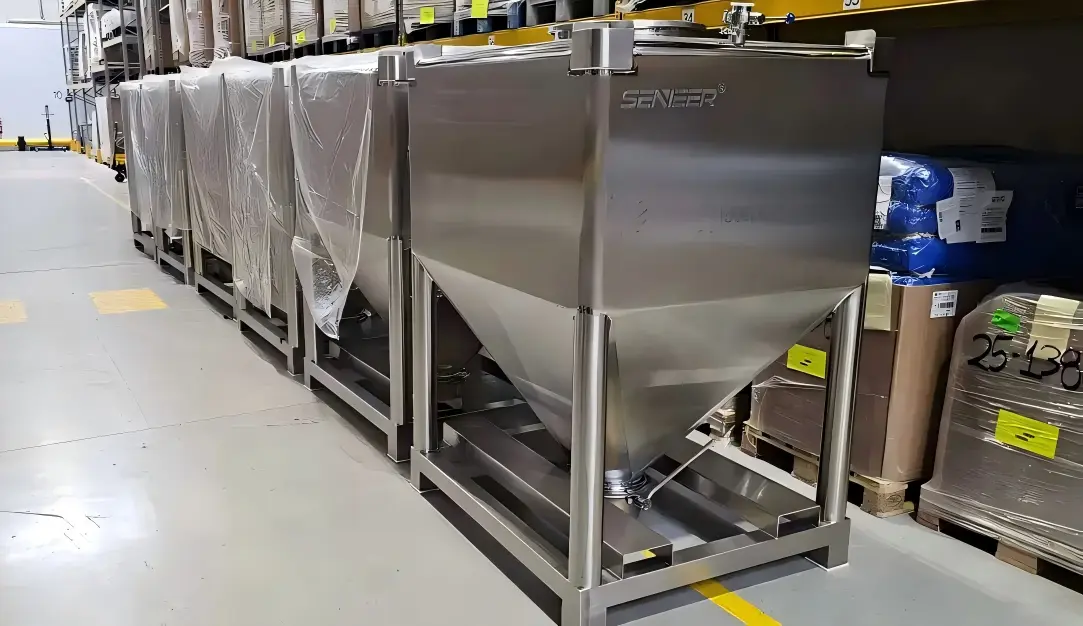
Chapter 1:How to select the right bin?
Effective and suitable loading volume
To keep one batch one bin or two bin, to avoid frequent bin splitting and bin merging shall, to reduce contamination and cross-contact.
Match room layout
The overall height and bin diameter must conform to the layer height standards and storage position width of the intermediate station racks. If stacking is required, stacking positioning structures must be equipped, and the layer height shall accommodate the total height after stacking.
Hopper Angle
General rule:
The hopper inclination angle must be 5°~10° greater than the material angle of repose.
Ordinary dry granules: 60° hopper angle
Fine powder, viscous materials and materials prone to bridging: 65°~70° hopper angle, pneumatic vibrators or fluidization devices can be equipped.
Discharge outlet diameter:
≥DN150 for powder and small granules
≥DN200~DN300 for large and fragile granules.
GMP and Cleaning Compliance
There are some points that deserve attention
- Contact surfaces: 316L/304 stainless steel, Ra ≤ 8 μm; inner and outer mirror surfaces are polished
- all welds are fully welded and polished
- no dead zones, powder accumulation, or grooves are present
- the height and diameter allow access to the automatic cleaning station
- the internal structure has any spray blind spots
- cleaning validation for irregularly shaped or excessively tall bins is difficult to pass
- The sealing ring material is resistant to disinfectants and withstands high-temperature sterilization
Chapter 2:Stainless steel or plastic bin?
We provide a complete comparison table and hope it can be helpful to you.
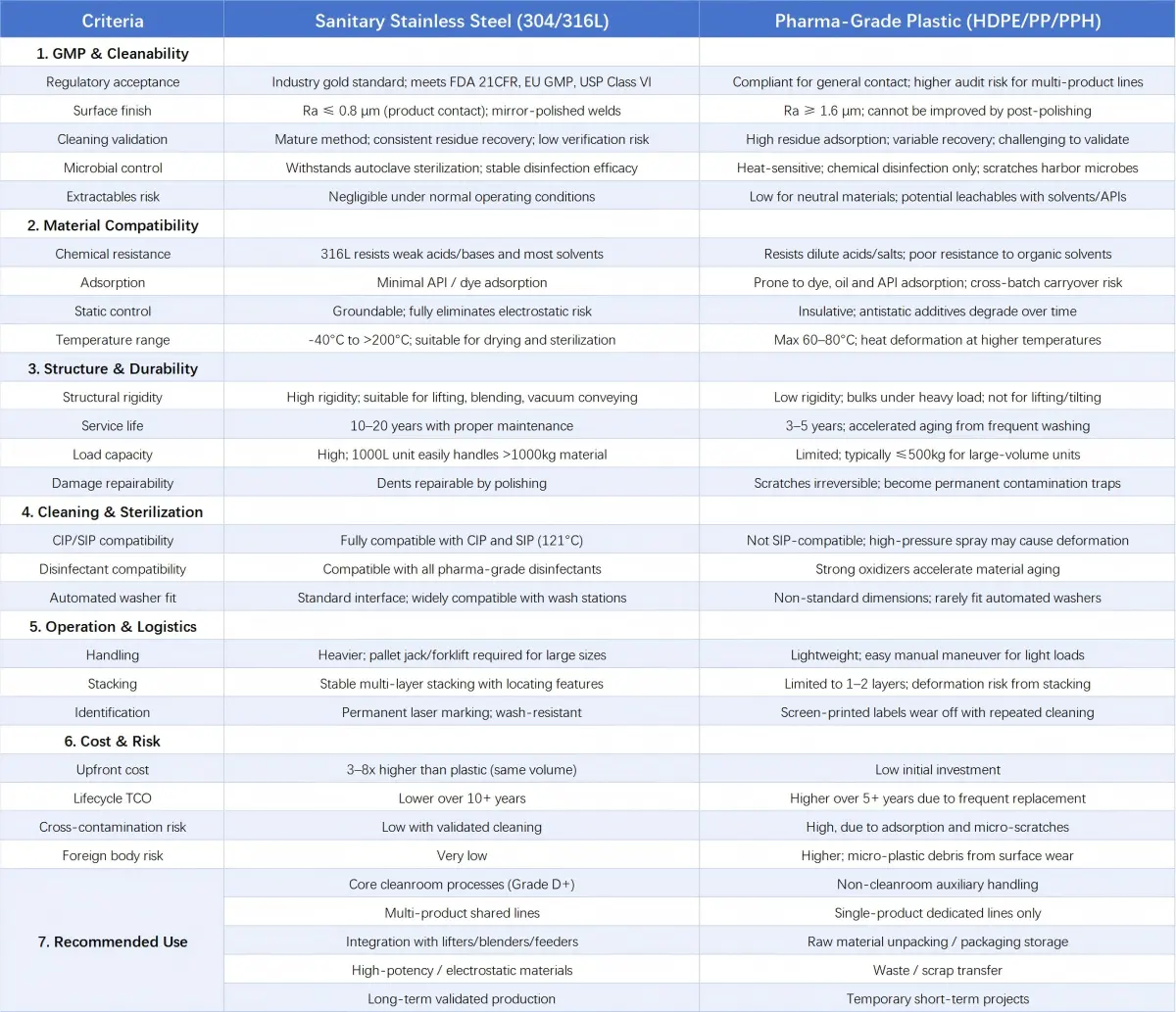
If you have any questions regarding the choice of stainless steel material, you can check this.
Chapter 3:Should I choose an IBC bin or standard container?
It depends on your needs
IBCs are the better choice if your primary use case falls into any of these categories:
- Bulk raw material / API handling: For receiving, storing and transferring large batches (≥1000L) of excipients or active ingredients between the warehouse and production buffer zones.
- Cross-plant / long-distance logistics: When materials move between separate buildings or across large facility footprints, forklift-transported IBCs are far more efficient than manual transfer.
- Bulk finished product shipment: For sending bulk intermediates or finished products to external packaging facilities or customers.
- Warehouse space optimization: If storage capacity is tight, stackable IBCs with standard pallet dimensions maximize both vertical and horizontal space usage.
- Single-product campaigns: For dedicated production lines with infrequent changeovers, where cleaning validation complexity is less of a concern.
- Free-flowing materials: Works best for granules, pellets or free-flowing powders with low bridging and sticking risk.
Chapter 4:What bin is suitable for GMP production?
In fact, the vast majority of reputable IBC bin manufacturers must undergo DQ (Design Qualification), IQ (Installation Qualification), OQ (Operational Qualification), and PQ (Performance Qualification) to verify that the bins comply with both design specifications and process requirements—such as those for Mixing bins, Blending bins, and Transport bins produced by Senieer.
Chapter 5:How to avoid contamination during material transfer?
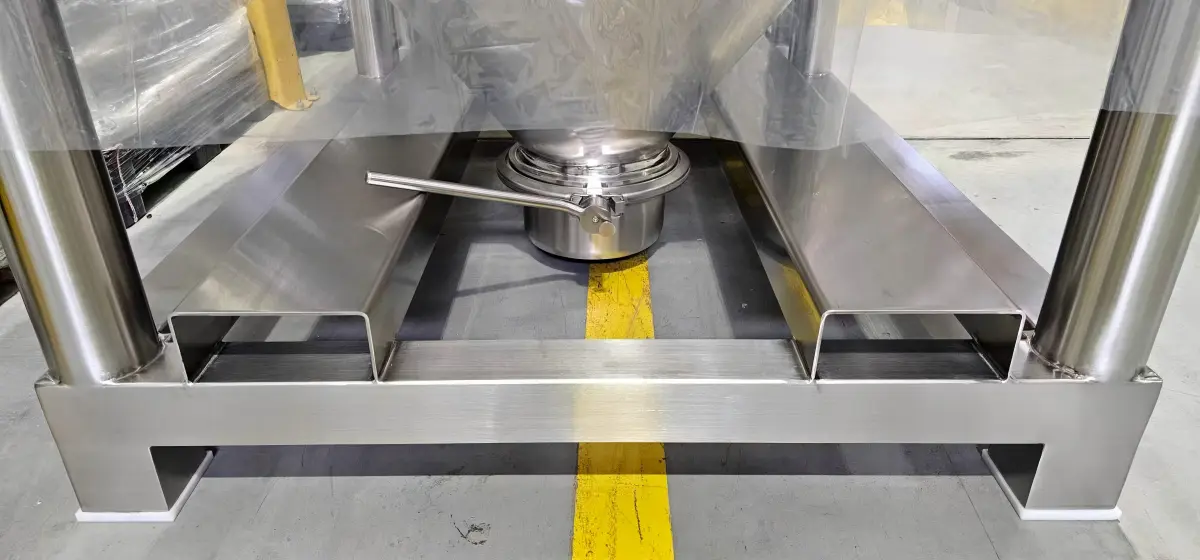
Discharge port
Discharge port plays an important role in preventing cross-contamination and dust escape during material transfer. We provide multiple types of bin discharge ports, such as butterfly valve outlets, split cone discharge outlets, and rapid-transfer closed ports. Closed connection design minimizes powder leakage and direct exposure to ambient air.
Sealing ring
Food/pharma-grade elastomer sealing rings are adopted. Materials include silicone, EPDM. Seals ensure tight closure at the discharge interface to stop dust ingress and material leakage. Seals shall be easily detachable for full cleaning and inspection, no dead corners for material accumulation. Regular replacement schedule avoids aging and sealing failure.
Bin Body
The bin body is fully GMP-compliant. Smooth internal surface with low Ra value, no welding crevices, no dead zones where residues can build up. Rounded internal corners facilitate complete emptying and CIP/WIP cleaning. Material conforms to veterinary/pharmaceutical contact material standards to prevent substance migration and cross-contamination.